
Annular solar eclipse of 9 May 2032
On 9 May 2032 the Moon passes directly in front of the Sun. It is too far from Earth to cover it completely, so along a path about 44 km wide a bright ring of sunlight stays visible: the "ring of fire". The path crosses the southern Atlantic. At greatest eclipse, annularity lasts 22s. The central path stays over open water, so annularity is not seen from land.
A partial eclipse is visible from southern South America and southern Africa. The Sun is never fully covered, so you need certified eclipse glasses for the whole eclipse.
Countdown to the eclipse
9 May 2032 · Annular solar eclipse
Counting down to the moment the Moon's umbra first touches Earth, starting the path of annularity (9 May 2032, 12:46:21 UTC, from NASA's eclipse data).
The shaded band is the path of annularity. Tap anywhere for your exact seconds, contact times and local sunrise and sunset, computed from NASA Besselian elements.
The eclipse in charts
Where the shadow goes
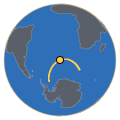
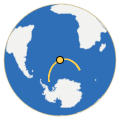
The gold band is the path of totality on the globe. The dot marks greatest eclipse.
Seconds of annularity along the centre line
How long annularity lasts for someone standing on the centre line, from the sunrise end of the path (left) to the sunset end (right).
How fast the shadow moves
The shadow is slowest where the Sun is high and races at the sunrise and sunset ends of the path.
How much of the Sun is covered
Outside the path of annularity, a band about 44 km wide, you only get a partial eclipse.
Overview
The annular solar eclipse of 9 May 2032 is the only annular solar eclipse of 2032.
Greatest eclipse, the moment the Moon's shadow passes closest to the centre of the Earth, comes at 13:25:32 UTC, over the open sea, about 1450 km from the nearest land (South Georgia) (51.3°S, 7.1°W), with the Sun 20° above the horizon. There annularity lasts 22s. The path of annularity is a band about 44 km wide at that point.
- Sunrise end: the shadow touches down at about 12:47 UTC, over the open sea, about 720 km from the nearest land (Antarctica).
- Path crosses: the southern Atlantic.
- Sunset end: the shadow leaves the Earth at about 14:04 UTC, over the open sea, about 1080 km from the nearest land (South Africa).
- Longest on land: none, as the path stays over open water.
- Partial eclipse: visible from southern South America and southern Africa.
Annular solar eclipse, explained
On 9 May 2032 the Moon is too far from Earth to cover the Sun. With a magnitude of 0.996, below 1, it leaves a ring of fire for up to 22s inside a band about 44 km wide. The ring is never safe to look at without eclipse glasses. How annular eclipses work: the full guide →
Key facts
| Date | 9 May 2032 |
|---|---|
| Type | AnnularThe Moon is too small to cover the Sun, leaving a ring of sunlight. |
| Greatest eclipse | 13:26:42 TD · 13:25:32 UTCThe moment the shadow passes closest to the centre of the Earth. TD is the astronomers’ uniform time scale; UTC is clock time. |
| ΔT | 69.7 sBased on Earth’s measured rotation (IERS). NASA’s canon assumed 79 s, so its UTC is 9 s earlier.The gap between that uniform time and clock time, because the Earth’s spin slowly varies. |
| Greatest eclipse at | 51.3°S, 7.1°WOver the open sea, about 1450 km from the nearest land (South Georgia). |
| Magnitude | 0.9957How much of the Sun’s width the Moon covers. Above 1 means the whole Sun is hidden. |
| Sun altitude at greatest eclipse | 20°How high the Sun stands above the horizon there (90° would be straight overhead). |
| Path width | 44 kmHow wide the band of annularity is at greatest eclipse. |
| Central duration | 22sHow long annularity lasts on the centre line at greatest eclipse. |
| Gamma | -0.9375How far the shadow’s axis passes from the centre of the Earth, in Earth radii. Near 0 is dead centre; near 1 it grazes the poles. |
| Saros series | 148 (member 22 of 75)The eclipse family this one belongs to (see below). |
| Lunation number | 400The count of new moons since January 2000. |
Lunar date and phase
A solar eclipse happens only at new moon, when the Moon is between the Earth and the Sun. On the Chinese lunar calendar this is 四月初一 (month 4, day 1) of the 壬子 year, the year of the Rat.
What is Saros 148?
- Family: 75 solar eclipses, 21 September 1653 to 12 December 2987.
- This one: number 22 of 75.
- Rhythm: one every 18 years, 11 days and about 8 hours, each about 120° of longitude further west.
- Previous: annular eclipse, 29 April 2014.
- Next: hybrid eclipse, 20 May 2050.
Why eclipse families exist, and where the name comes from →
All 75 eclipses in Saros 148
21 September 1653 (Pb) · 2 October 1671 (P) · 13 October 1689 (P) · 25 October 1707 (P) · 4 November 1725 (P) · 16 November 1743 (P) · 26 November 1761 (P) · 7 December 1779 (P) · 18 December 1797 (P) · 30 December 1815 (P) · 9 January 1834 (P) · 21 January 1852 (P) · 31 January 1870 (P) · 11 February 1888 (P) · 23 February 1906 (P) · 5 March 1924 (P) · 16 March 1942 (P) · 27 March 1960 (P) · 7 April 1978 (P) · 17 April 1996 (P) · 29 April 2014 (A-) · 9 May 2032 (A) · 20 May 2050 (H) · 31 May 2068 (T) · 11 June 2086 (T) · 22 June 2104 (T) · 4 July 2122 (T) · 14 July 2140 (T) · 25 July 2158 (T) · 4 August 2176 (T) · 16 August 2194 (T) · 27 August 2212 (T) · 7 September 2230 (T) · 18 September 2248 (T) · 29 September 2266 (T) · 9 October 2284 (T) · 22 October 2302 (T) · 1 November 2320 (Tm) · 12 November 2338 (T) · 23 November 2356 (T) · 4 December 2374 (T) · 14 December 2392 (T) · 26 December 2410 (T) · 5 January 2429 (T) · 17 January 2447 (T) · 27 January 2465 (T) · 7 February 2483 (T) · 19 February 2501 (T) · 2 March 2519 (T) · 12 March 2537 (T) · 24 March 2555 (T) · 3 April 2573 (T) · 14 April 2591 (T) · 26 April 2609 (T) · 7 May 2627 (T) · 17 May 2645 (T) · 29 May 2663 (T) · 8 June 2681 (T) · 19 June 2699 (T) · 1 July 2717 (T) · 12 July 2735 (T) · 22 July 2753 (T) · 3 August 2771 (T) · 13 August 2789 (P) · 24 August 2807 (P) · 4 September 2825 (P) · 15 September 2843 (P) · 25 September 2861 (P) · 7 October 2879 (P) · 17 October 2897 (P) · 29 October 2915 (P) · 9 November 2933 (P) · 20 November 2951 (P) · 30 November 2969 (P) · 12 December 2987 (Pe)
Every eclipse to 2035, each with its own map
Already thinking beyond 2026? Here are the next eclipses from today. Every solar and lunar eclipse has its own interactive map with local times for any spot on Earth.
Last updated
Frequently asked questions
What kind of eclipse will be the 9 May 2032 event?
The 9 May 2032 eclipse will be a annular solar eclipse. The Moon will leave a bright ring of Sun visible along the central path.
What is the difference between total, annular and partial eclipses?
Total: the Moon covers the Sun completely and the corona appears. Annular: the Moon is a little too far from Earth, so a bright ring of Sun stays visible and you need glasses throughout. Partial: the Moon only covers part of the Sun.
What is a saros?
A cycle of about 18 years, 11 days and 8 hours after which the Sun, Moon and Earth return to almost the same geometry, so a very similar eclipse repeats. Eclipses in one saros series are numbered as a family.
What does eclipse magnitude mean?
Magnitude is the fraction of the Sun's diameter covered by the Moon. 0.80 means 80% of the width is covered. It is not the same as “% covered”, which on this site always means obscuration, the share of the Sun's area hidden: a magnitude of 0.80 hides only about 75% of the Sun's area. Anything 1.00 or above at your spot means a total eclipse.
Do I need eclipse glasses?
Yes, for every moment the Sun is even slightly uncovered. Use ISO 12312-2 certified glasses from a reputable seller. Only during totality itself is it safe to look with the naked eye.
Data: NASA Five Millennium Canon of Solar Eclipses (Espenak & Meeus). Eclipse Predictions by Fred Espenak, NASA's GSFC. Centre line, durations and shadow speed computed from NASA Besselian elements. Place search by Photon (komoot) · © OpenStreetMap contributors.