
Total solar eclipse of 2 September 2035
On 2 September 2035 the Moon passes directly in front of the Sun. Along a path about 116 km wide the Sun is completely covered and day turns to twilight. The path crosses China, Korea, Japan and the Pacific. At greatest eclipse, totality lasts 2m 54s. The longest totality on land is 2m 37s, about 16 km south of Mito, Japan.
A partial eclipse is visible from eastern Asia and the Pacific. Outside the path you only see a partial eclipse, and you need eclipse glasses for every moment except totality itself.
Countdown to the eclipse
2 September 2035 · Total solar eclipse
Counting down to the moment the Moon's umbra first touches Earth, starting the path of totality (2 Sep 2035, 00:15:46 UTC, from NASA's eclipse data).
The shaded band is the path of totality. Tap anywhere for your exact seconds, contact times and local sunrise and sunset, computed from NASA Besselian elements.
The eclipse in charts
Where the shadow goes
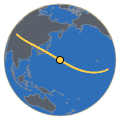
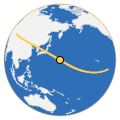
The gold band is the path of totality on the globe. The dot marks greatest eclipse.
Seconds of totality along the centre line
How long totality lasts for someone standing on the centre line, from the sunrise end of the path (left) to the sunset end (right).
How fast the shadow moves
The shadow is slowest where the Sun is high and races at the sunrise and sunset ends of the path.
How much of the Sun is covered
Outside the path of totality, a band about 116 km wide, you only get a partial eclipse. Even 90% is nothing like totality.
Overview
The total solar eclipse of 2 September 2035 is the only total solar eclipse of 2035.
Greatest eclipse, the moment the Moon's shadow passes closest to the centre of the Earth, comes at 01:55:36 UTC, over the open ocean, far from any land (29.1°N, 158°E), with the Sun 68° above the horizon. There totality lasts 2m 54s. The path of totality is a band about 116 km wide at that point.
- Sunrise end: the shadow touches down at about 00:16 UTC, in China, about 180 km north-east of Hotan.
- Path crosses: China, Korea, Japan and the Pacific.
- Sunset end: the shadow leaves the Earth at about 03:35 UTC, over the open sea, about 1390 km from the nearest land (Kiribati).
- Longest on land: 2m 37s of totality, about 16 km south of Mito, Japan.
- Partial eclipse: visible from eastern Asia and the Pacific.
Total solar eclipse, explained
On 2 September 2035 the Moon hides the whole Sun for up to 2m 54s inside a band about 116 km wide. Magnitude 1.032: the Moon looks slightly larger than the Sun, so day turns to twilight and the corona comes out. Outside the band people see a partial eclipse. How total eclipses work: the full guide →
Key facts
| Date | 2 September 2035 |
|---|---|
| Type | TotalThe Moon covers the whole Sun somewhere along the path. |
| Greatest eclipse | 01:56:46 TD · 01:55:36 UTCThe moment the shadow passes closest to the centre of the Earth. TD is the astronomers’ uniform time scale; UTC is clock time. |
| ΔT | 70.0 sBased on Earth’s measured rotation (IERS). NASA’s canon assumed 81 s, so its UTC is 11 s earlier.The gap between that uniform time and clock time, because the Earth’s spin slowly varies. |
| Greatest eclipse at | 29.1°N, 158°EOver the open ocean, far from any land. |
| Magnitude | 1.0320How much of the Sun’s width the Moon covers. Above 1 means the whole Sun is hidden. |
| Sun altitude at greatest eclipse | 68°How high the Sun stands above the horizon there (90° would be straight overhead). |
| Path width | 116 kmHow wide the band of totality is at greatest eclipse. |
| Central duration | 2m 54sHow long totality lasts on the centre line at greatest eclipse. |
| Gamma | 0.3727How far the shadow’s axis passes from the centre of the Earth, in Earth radii. Near 0 is dead centre; near 1 it grazes the poles. |
| Saros series | 145 (member 23 of 76)The eclipse family this one belongs to (see below). |
| Lunation number | 441The count of new moons since January 2000. |
Lunar date and phase
A solar eclipse happens only at new moon, when the Moon is between the Earth and the Sun. On the Chinese lunar calendar this is 八月初一 (month 8, day 1) of the 乙卯 year, the year of the Rabbit.
What is Saros 145?
- Family: 76 solar eclipses, 4 January 1639 to 6 April 2991.
- This one: number 23 of 76.
- Rhythm: one every 18 years, 11 days and about 8 hours, each about 120° of longitude further west.
- Previous: total eclipse, 21 August 2017.
- Next: total eclipse, 12 September 2053.
Why eclipse families exist, and where the name comes from →
All 76 eclipses in Saros 145
4 January 1639 (Pb) · 14 January 1657 (P) · 25 January 1675 (P) · 5 February 1693 (P) · 17 February 1711 (P) · 27 February 1729 (P) · 11 March 1747 (P) · 21 March 1765 (P) · 1 April 1783 (P) · 13 April 1801 (P) · 24 April 1819 (P) · 4 May 1837 (P) · 16 May 1855 (P) · 26 May 1873 (P) · 6 June 1891 (A) · 17 June 1909 (H) · 29 June 1927 (T) · 9 July 1945 (T) · 20 July 1963 (T) · 31 July 1981 (T) · 11 August 1999 (T) · 21 August 2017 (T) · 2 September 2035 (T) · 12 September 2053 (T) · 23 September 2071 (T) · 4 October 2089 (T) · 16 October 2107 (T) · 26 October 2125 (T) · 7 November 2143 (T) · 17 November 2161 (T) · 28 November 2179 (T) · 9 December 2197 (T) · 21 December 2215 (T) · 31 December 2233 (T) · 12 January 2252 (T) · 22 January 2270 (T) · 2 February 2288 (T) · 14 February 2306 (T) · 25 February 2324 (Tm) · 8 March 2342 (T) · 18 March 2360 (T) · 29 March 2378 (T) · 9 April 2396 (T) · 20 April 2414 (T) · 30 April 2432 (T) · 12 May 2450 (T) · 22 May 2468 (T) · 2 June 2486 (T) · 14 June 2504 (T) · 25 June 2522 (T) · 5 July 2540 (T) · 17 July 2558 (T) · 27 July 2576 (T) · 7 August 2594 (T) · 18 August 2612 (T) · 30 August 2630 (T) · 9 September 2648 (Ts) · 20 September 2666 (P) · 1 October 2684 (P) · 13 October 2702 (P) · 23 October 2720 (P) · 4 November 2738 (P) · 14 November 2756 (P) · 25 November 2774 (P) · 6 December 2792 (P) · 17 December 2810 (P) · 28 December 2828 (P) · 8 January 2847 (P) · 18 January 2865 (P) · 30 January 2883 (P) · 10 February 2901 (P) · 21 February 2919 (P) · 4 March 2937 (P) · 15 March 2955 (P) · 25 March 2973 (P) · 6 April 2991 (P)
Every eclipse to 2035, each with its own map
Already thinking beyond 2026? Here are the next eclipses from today. Every solar and lunar eclipse has its own interactive map with local times for any spot on Earth.
Last updated
Frequently asked questions
What kind of eclipse will be the 2 September 2035 event?
The 2 September 2035 eclipse will be a total solar eclipse. The Moon will cover the Sun completely along a narrow path.
What is the difference between total, annular and partial eclipses?
Total: the Moon covers the Sun completely and the corona appears. Annular: the Moon is a little too far from Earth, so a bright ring of Sun stays visible and you need glasses throughout. Partial: the Moon only covers part of the Sun.
What is a saros?
A cycle of about 18 years, 11 days and 8 hours after which the Sun, Moon and Earth return to almost the same geometry, so a very similar eclipse repeats. Eclipses in one saros series are numbered as a family.
What does eclipse magnitude mean?
Magnitude is the fraction of the Sun's diameter covered by the Moon. 0.80 means 80% of the width is covered. It is not the same as “% covered”, which on this site always means obscuration, the share of the Sun's area hidden: a magnitude of 0.80 hides only about 75% of the Sun's area. Anything 1.00 or above at your spot means a total eclipse.
Do I need eclipse glasses?
Yes, for every moment the Sun is even slightly uncovered. Use ISO 12312-2 certified glasses from a reputable seller. Only during totality itself is it safe to look with the naked eye.
Data: NASA Five Millennium Canon of Solar Eclipses (Espenak & Meeus). Eclipse Predictions by Fred Espenak, NASA's GSFC. Centre line, durations and shadow speed computed from NASA Besselian elements. Place search by Photon (komoot) · © OpenStreetMap contributors.