
Total solar eclipse of 12 August 2026
The total solar eclipse of 12 August 2026 crossed the Arctic, eastern Greenland, western Iceland and northern Spain. The longest totality on land, about 2m 18s, fell on Greenland's uninhabited Blosseville Coast; in Iceland it was 2m 13s at Látrabjarg, the westernmost point. In Spain the Sun was low in the sky at totality, just north of due west.
Spain sees totality again just under a year later, on 2 August 2027, this time across the far south.
This eclipse has passed. This page is kept as a record.
ECLIPSE:SECONDSESAS · Eclipse Seconds Alerts ServiceYour eclipse starts here. Free alerts, exact times, cloud forecasts and expert guides.Tap anywhere for your exact seconds, contact times and local sunrise and sunset.
A place in history
Spain's first total solar eclipse since 30 August 1905, and the first of three Spanish eclipses in under two years: the total eclipse of 2 August 2027 in the far south and the annular eclipse of 26 January 2028 follow.
The eclipse in charts
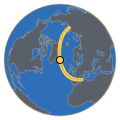
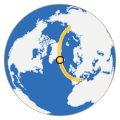
Where the shadow goes
The gold band is the path of totality on the globe. The dot marks greatest eclipse.
Timeline in Burgos
C1 partial starts, C2 totality starts, C3 totality ends, C4 partial ends (local time).
- C119:33Partial begins
- C220:28Totality begins
- Max20:29Maximum
- C320:30Totality ends
- C421:21Partial ends
Seconds of totality along the centre line
How long totality lasted for someone standing on the centre line, from sunrise in the Arctic (left) to sunset over the Mediterranean (right).
How fast the shadow moves
The shadow is slowest where the Sun is high and races at the sunrise and sunset ends of the path.
How much of the Sun is covered
Outside the path of totality, a band about 294 km wide, you only get a partial eclipse. Even 90% is nothing like totality.
Overview
The total solar eclipse of 12 August 2026 was the only total solar eclipse of 2026 and the first seen from mainland Europe since 1999.
Greatest eclipse, the moment the Moon's shadow passed closest to the centre of the Earth, came at 17:45:57 UTC, over the sea about 45 km off the west coast of Iceland (65.2°N, 25.2°W), with the Sun 26° above the horizon. There totality lasted 2m 18s. The path of totality was a band about 294 km wide at that point.
- Sunrise end: the shadow touched down at about 16:58 UTC, over the sea just off northern Siberia.
- Path crossed: the Arctic near the North Pole, eastern Greenland, western Iceland, northern Spain and a sliver of north-eastern Portugal.
- Spain: totality arrived at about 18:27 UTC, with the Sun low in the sky, just north of due west.
- Sunset end: the shadow left the Earth at about 18:34 UTC, over the Mediterranean near the Balearic Islands.
- Partial eclipse: seen across Europe, North Africa, the Arctic and northern North America.
Total solar eclipse, explained
On 12 August 2026 the Moon hid the whole Sun for up to 2m 18s inside a band about 294 km wide. Magnitude 1.039: the Moon looked slightly larger than the Sun, so day turned to twilight and the corona came out. Outside the band people saw a partial eclipse. How total eclipses work: the full guide →
Key facts
| Date | 12 August 2026 |
|---|---|
| Type | TotalThe Moon covers the whole Sun somewhere along the path. |
| Greatest eclipse | 17:47:06 TD · 17:45:57 UTCThe moment the shadow passes closest to the centre of the Earth. TD is the astronomers’ uniform time scale; UTC is clock time. |
| ΔT | 69.2 sBased on Earth’s measured rotation (IERS). NASA’s canon assumed 75 s, so its UTC is 6 s earlier.The gap between that uniform time and clock time, because the Earth’s spin slowly varies. |
| Greatest eclipse at | 65.2°N, 25.2°WOver the sea about 45 km off the west coast of Iceland. |
| Magnitude | 1.0386How much of the Sun’s width the Moon covers. Above 1 means the whole Sun is hidden. |
| Sun altitude at greatest eclipse | 26°How high the Sun stands above the horizon there (90° would be straight overhead). |
| Path width | 294 kmHow wide the band of totality is at greatest eclipse. |
| Central duration | 2m 18sHow long totality lasts on the centre line at greatest eclipse. |
| Gamma | 0.8977How far the shadow’s axis passes from the centre of the Earth, in Earth radii. Near 0 is dead centre; near 1 it grazes the poles. |
| Saros series | 126 (member 48 of 72)The eclipse family this one belongs to (see below). |
| Lunation number | 329The count of new moons since January 2000. |
Lunar date and phase
A solar eclipse happens only at new moon, when the Moon is between the Earth and the Sun. On the Chinese lunar calendar this is 六月三十 (month 6, day 30) of the 丙午 year, the year of the Horse.
What is Saros 126?
- Family: 72 solar eclipses, 10 March 1179 to 3 May 2459.
- This one: number 48 of 72.
- Rhythm: one every 18 years, 11 days and about 8 hours, each about 120° of longitude further west.
- Previous: total eclipse, 1 August 2008.
- Next: total eclipse, 23 August 2044.
Why eclipse families exist, and where the name comes from →
All 72 eclipses in Saros 126
10 March 1179 (Pb) · 20 March 1197 (P) · 31 March 1215 (P) · 11 April 1233 (P) · 22 April 1251 (P) · 2 May 1269 (P) · 14 May 1287 (P) · 24 May 1305 (P) · 4 June 1323 (As) · 14 June 1341 (A) · 26 June 1359 (A) · 6 July 1377 (A) · 17 July 1395 (A) · 27 July 1413 (A) · 8 August 1431 (A) · 18 August 1449 (A) · 29 August 1467 (A) · 9 September 1485 (A) · 20 September 1503 (A) · 30 September 1521 (A) · 12 October 1539 (A) · 22 October 1557 (A) · 2 November 1575 (A) · 22 November 1593 (A) · 4 December 1611 (A) · 14 December 1629 (A) · 26 December 1647 (A) · 5 January 1666 (A) · 16 January 1684 (A) · 28 January 1702 (A) · 8 February 1720 (A) · 18 February 1738 (A) · 1 March 1756 (A) · 12 March 1774 (A) · 22 March 1792 (A) · 4 April 1810 (A) · 14 April 1828 (Hm) · 25 April 1846 (H) · 6 May 1864 (H) · 17 May 1882 (T) · 28 May 1900 (T) · 8 June 1918 (T) · 19 June 1936 (T) · 30 June 1954 (T) · 10 July 1972 (T) · 22 July 1990 (T) · 1 August 2008 (T) · 12 August 2026 (T) · 23 August 2044 (T) · 3 September 2062 (P) · 13 September 2080 (P) · 25 September 2098 (P) · 6 October 2116 (P) · 17 October 2134 (P) · 28 October 2152 (P) · 8 November 2170 (P) · 18 November 2188 (P) · 1 December 2206 (P) · 11 December 2224 (P) · 22 December 2242 (P) · 2 January 2261 (P) · 13 January 2279 (P) · 23 January 2297 (P) · 5 February 2315 (P) · 15 February 2333 (P) · 27 February 2351 (P) · 9 March 2369 (P) · 20 March 2387 (P) · 31 March 2405 (P) · 11 April 2423 (P) · 21 April 2441 (P) · 3 May 2459 (Pe)
Every eclipse to 2035, each with its own map
Already thinking beyond 2026? Here are the next eclipses from today. Every solar and lunar eclipse has its own interactive map with local times for any spot on Earth.
Last updated
Frequently asked questions
Where was the 12 August 2026 eclipse total?
Over the Arctic, eastern Greenland, western Iceland and northern Spain. The longest totality on land was about 2m 18s on Greenland's uninhabited Blosseville Coast. In Iceland it was about 2m 13s at Látrabjarg, the westernmost point; in Spain about 1m 50s on the north coast of Asturias and Lugo (IGN figures). At greatest eclipse, over the sea just off Iceland, it lasted 2m 18s.
Why is the Sun so low in Spain?
The eclipse happens near sunset in Spain, so the Sun is only around 10° above the western horizon. A clear, low western view matters more than anything else.
What do C1, C2, C3 and C4 mean?
They are the four 'contacts' of an eclipse. C1: the Moon first touches the Sun and the partial eclipse begins. C2: the last sliver of Sun disappears and totality starts. C3: the Sun reappears and totality ends. C4: the Moon leaves the Sun and the eclipse is over.
Do I need eclipse glasses?
Yes, for every moment the Sun is even slightly uncovered. Use ISO 12312-2 certified glasses from a reputable seller. Only during totality itself is it safe to look with the naked eye.
What is Saros 126?
The family of eclipses this one belongs to. Eclipses in a saros repeat every 18 years, 11 days and about 8 hours with almost the same geometry. Read more about Saros 126 ↑
Data: NASA Five Millennium Canon of Solar Eclipses (Espenak & Meeus). Eclipse Predictions by Fred Espenak, NASA's GSFC. Centre line, durations and shadow speed computed from NASA Besselian elements. Place search by Photon (komoot) · © OpenStreetMap contributors.