Where to watch the 2 August 2027 total solar eclipse
Published · Updated
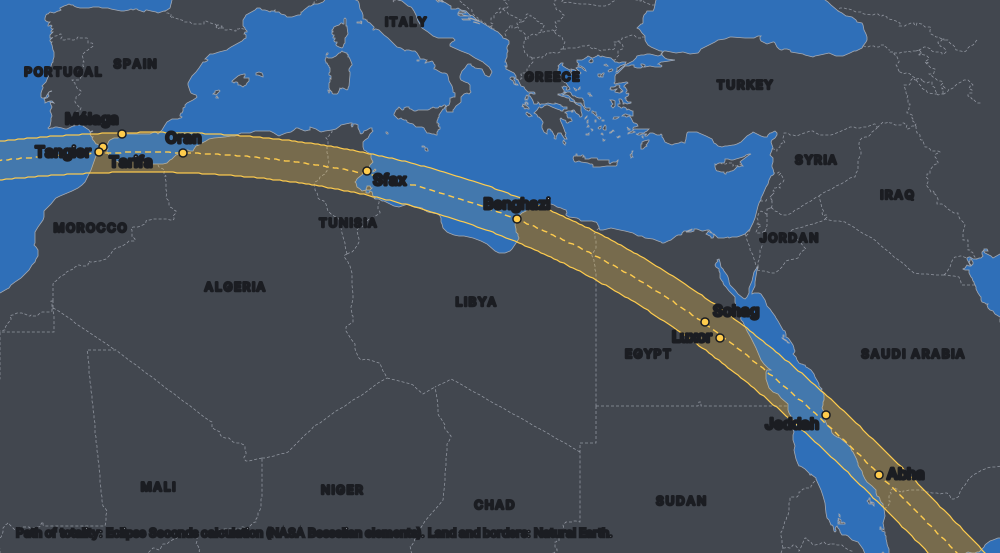
The 2 August 2027 eclipse crosses southern Spain, North Africa and Arabia, with up to 6m 23s of totality on land, on the centre line near Sohag in Egypt. Where you stand decides three things: how many seconds of totality you get, how high the Sun is, and how likely clouds are. This guide compares 42 places on those three measures, using our calculator (NASA Besselian elements, validated to within 1–2 s of independent references).

SpainGibraltarMoroccoAlgeriaTunisiaLibyaEgyptSaudi ArabiaYemenSomalia
The short answer
- Longest and clearest: the Nile valley around Sohag and Luxor, Egypt (about 6m 20s, high Sun, lowest cloud).
- Long totality, more cloud risk: Benghazi, Libya and Jeddah, Saudi Arabia (about 6 minutes).
- Closest to Europe: Tangier or Tétouan, Morocco, and Ceuta or Tarifa, Spain (about 4m 40s to 4m 51s, low Sun).
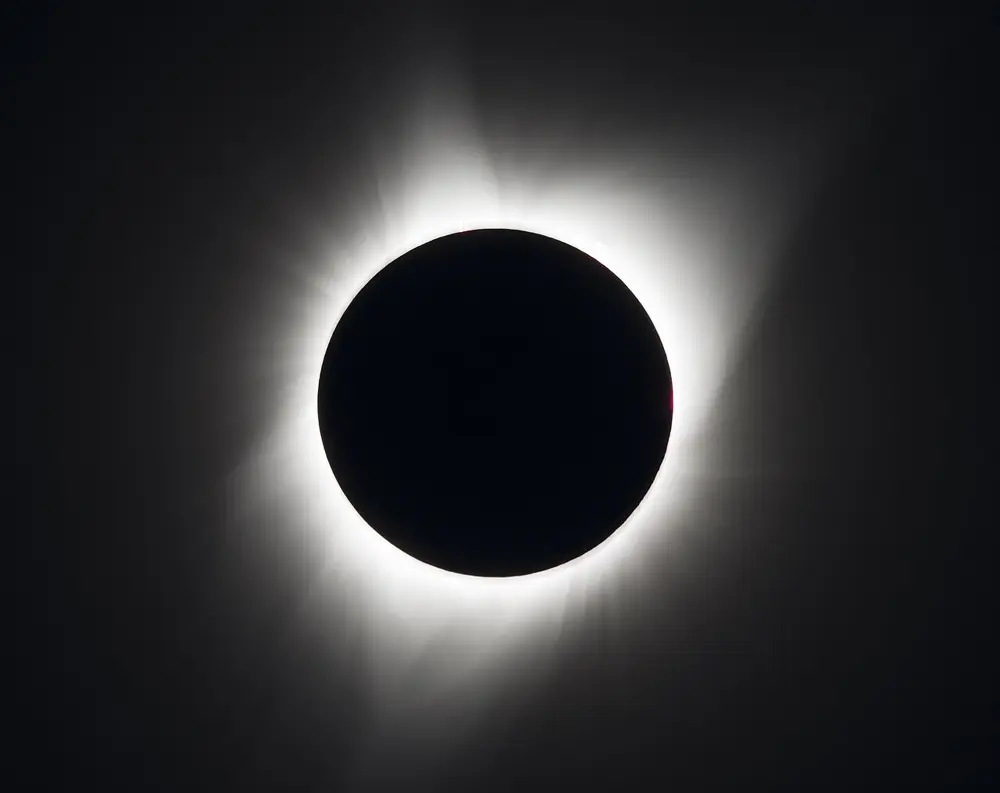
At greatest eclipse near Luxor the Moon's umbral shadow races across the ground at about 2,402 km/h (1,493 mph). Near the ends of the path, over the Atlantic and Arabia, it is much faster. See our FAQ on shadow speed.
Every town below is ranked on three things: seconds of totality, Sun altitude and August cloud. The chart shows the first at a glance.
Compare places side by side, ranked by totality, clear skies or Sun height →
Seconds of totality at each town centre
Longer bars mean more totality. Egypt towns are the brightest gold.
Egypt: the longest totality and the clearest skies
The Nile valley between Asyut and Esna is the strongest choice on the whole track. Spots on the centre line near Sohag get up to 6m 23s, the longest on land (6m 22s in Sohag town centre), and Luxor town centre 6m 21s, with the Sun about 81–82° up and a mean August cloud amount of 7–9%. Totality begins around 13:00 local time.
Two traps: Aswan lies just outside the southern limit and Safaga just outside the northern limit, with El Quseir only just inside the northern edge (about 2m 20s to 2m 30s). Marsa Alam, further south, keeps 5m 28s. Expect intense midday heat; plan shade and water as seriously as optics.
| Place | Totality | Begins (local) | Sun alt. | Aug cloud |
|---|---|---|---|---|
| Sohag, Egypt | 6m 22s | 12:58:48 | 81° | 7% |
| Luxor, Egypt | 6m 21s | 13:02:07 | 82° | 9% |
| Qena, Egypt | 6m 10s | 13:01:37 | 81° | 9% |
| Asyut, Egypt | 6m 06s | 12:56:56 | 81° | 7% |
| Esna, Egypt | 5m 45s–5m 47s | 13:02:52 | 82° | 9% |
| Edfu, Egypt | 5m 30s–5m 32s | 13:04:09 | 82° | 12% |
| Marsa Alam, Egypt | 5m 28s–5m 31s | 13:08:05 | 81° | 12% |
| El Quseir, Egypt | 2m 19s–2m 32s | 13:06:46 | 81° | 24% |
| Safaga, Egypt | Outside path | – | 80° | 8% |
| Aswan, Egypt | Outside path | – | 83° | 12% |
Libya and Tunisia: long totality, harder access
Benghazi gets 6m 09s with the Sun at 68°. Tripoli and Misrata are outside the path. On the Tunisian coast Sfax gets 5m 39s, more than Djerba (4m 41s) or Gabès (4m 06s). Check current travel advice for Libya before planning.
| Place | Totality | Begins (local) | Sun alt. | Aug cloud |
|---|---|---|---|---|
| Benghazi, Libya | 6m 09s | 11:27:53 | 68° | 26% |
| Sfax, Tunisia | 5m 39s | 10:08:49 | 56° | 20% |
| Djerba (Houmt Souk), Tunisia | 4m 41s | 10:09:46 | 57° | 14% |
| Gabès, Tunisia | 4m 06s | 10:08:42 | 56° | 14% |
| Tripoli, Libya | Outside path | – | 60° | 10% |
| Misrata, Libya | Outside path | – | 62° | 19% |
Saudi Arabia: high Sun, more cloud
Jeddah gets 5m 58s and Abha 6m 03s, but mean August cloud is markedly higher (37% Jeddah, 59% Abha) than in the Nile valley. Taif, inland, gets just under 4 minutes.
| Place | Totality | Begins (local) | Sun alt. | Aug cloud |
|---|---|---|---|---|
| Abha, Saudi Arabia | 6m 03s | 13:34:17 | 71° | 59% |
| Jeddah, Saudi Arabia | 5m 58s | 13:22:24 | 76° | 37% |
| Taif, Saudi Arabia | 3m 49s–3m 56s | 13:26:07 | 75° | 47% |
Northern Morocco and Algeria: near the centre line
Tangier and Tétouan both get 4m 51s, about 12 seconds more than Tarifa across the Strait, with the Sun at 38°. Oran in Algeria reaches 5m 08s. Totality is mid-morning, around 08:45 Moroccan time.
| Place | Totality | Begins (local) | Sun alt. | Aug cloud |
|---|---|---|---|---|
| Oran, Algeria | 5m 08s | 09:51:06 | 43° | 26% |
| Tétouan, Morocco | 4m 51s | 08:45:11 | 38° | 22% |
| Tangier, Morocco | 4m 51s | 08:44:42 | 38° | 22% |
| Asilah, Morocco | 4m 45s | 08:44:25 | 38° | 30% |
| Al Hoceima, Morocco | 4m 26s | 08:47:01 | 40° | 40% |
| Nador, Morocco | 4m 15s | 08:48:22 | 41° | 37% |
| Chefchaouen, Morocco | 4m 13s | 08:45:29 | 39° | 22% |
| Tlemcen, Algeria | 3m 09s | 09:51:00 | 43° | 31% |
Southern Spain and Gibraltar: the European option
Spain is the easiest to reach from Europe, but totality is shorter and the Sun is low (37–41°). Ceuta (4m 48s) and Tarifa (4m 39s) are best; Málaga gets only 1m 50s and Ronda 1m 14s because they sit near the northern limit. Totality begins around 10:45 CEST.
Near the limit, a few kilometres change totality by tens of seconds. Do not pick a town by name: check your exact spot on the totality map.
| Place | Totality | Begins (local) | Sun alt. | Aug cloud |
|---|---|---|---|---|
| Ceuta, Spain | 4m 48s | 10:45:21 | 38° | 22% |
| Tarifa, Spain | 4m 39s | 10:45:09 | 38° | 19% |
| Melilla, Spain | 4m 34s | 10:48:14 | 41° | 37% |
| Algeciras, Spain | 4m 28s | 10:45:27 | 38° | 19% |
| Gibraltar, Gibraltar | 4m 27s | 10:45:35 | 38° | 19% |
| Zahara de los Atunes, Spain | 4m 24s | 10:45:02 | 38° | 19% |
| Vejer de la Frontera, Spain | 4m 06s | 10:45:05 | 38° | 19% |
| Conil de la Frontera, Spain | 4m 01s | 10:45:00 | 38° | 26% |
| Estepona, Spain | 3m 37s | 10:46:20 | 39° | 19% |
| Marbella, Spain | 3m 17s | 10:46:50 | 39° | 22% |
| Fuengirola, Spain | 3m 10s | 10:47:12 | 39° | 22% |
| Cádiz, Spain | 2m 54s | 10:45:25 | 37° | 26% |
| Málaga, Spain | 1m 50s | 10:48:10 | 39° | 22% |
| Jerez de la Frontera, Spain | 1m 39s | 10:46:17 | 38° | 26% |
| Ronda, Spain | 1m 14s | 10:47:37 | 39° | 19% |
How to choose
Seconds: stay close to the centre line; duration falls slowly near the middle and fast near the edges. Sun altitude: a high Sun clears horizon haze and buildings, but a low Sun makes it easier to frame the eclipse over a landscape. Cloud: the figures here are long-term August means from NASA POWER, not a forecast; keep a backup site you can drive to on the day.
Then sort out certified eclipse glasses for the partial phases, and see the 2027 eclipse hub for the countdown and the full path.
We may earn a small commission, at no extra cost to you. Affiliate disclosure
Near the path edge, a kilometre can change totality by tens of seconds, so always check your exact spot. Cloud figures on this site are long-term monthly means, not a forecast. Use ISO 12312-2 certified eclipse glasses for every partial phase; only totality is safe with the naked eye.
Frequently asked questions
Where is the best place to watch the 2027 eclipse?
For the longest totality and the clearest skies, Upper Egypt: Luxor gets over 6 minutes with very low August cloud. For a shorter trip from Europe, southern Spain or northern Morocco offer 1 to 5 minutes.
Is Spain or Egypt better?
Egypt wins on duration and weather; Spain wins on travel ease. In Spain the Sun is lower and coastal haze is a risk, so choose a spot with a clear view to the south-west.
What is the centre line?
The middle of the path of totality. Totality lasts longest there and gets shorter towards the edges, so moving a few kilometres towards the centre line can add seconds.
What is the path of totality?
The narrow track, usually 100 to 250 km wide, swept across Earth by the Moon's umbra. Only people inside it see the Sun fully covered. Just outside it, you get a deep partial eclipse that is a very different experience.
What do C1, C2, C3 and C4 mean?
They are the four 'contacts' of an eclipse. C1: the Moon first touches the Sun and the partial eclipse begins. C2: the last sliver of Sun disappears and totality starts. C3: the Sun reappears and totality ends. C4: the Moon leaves the Sun and the eclipse is over.