Forgot your eclipse glasses? Safe last-minute ways to watch
Published · Updated
The good news: you don't need glasses to enjoy an eclipse. The safest trick is to project the Sun onto the ground or a card and look at that. Here are the options, from easiest to most impressive.
1. Make a pinhole projector (5 minutes)
- Take two sheets of white card (or a cereal box).
- Make a small, clean hole in one with a pin or pencil tip. A square of kitchen foil taped over a larger hole gives a sharper image.
- Stand with your back to the Sun.
- Hold the card with the hole up, and the second card about 1 metre behind it in its shadow.
- A small crescent Sun appears on the lower card. Move the cards further apart for a bigger image.
View full-size diagram
Scroll sideways to see the whole diagram.
No card? Cross the fingers of both hands to make a little waffle grid, or poke a hole in a paper plate. The gaps project tiny crescents onto the ground.
2. Use a colander, straw hat or tree leaves
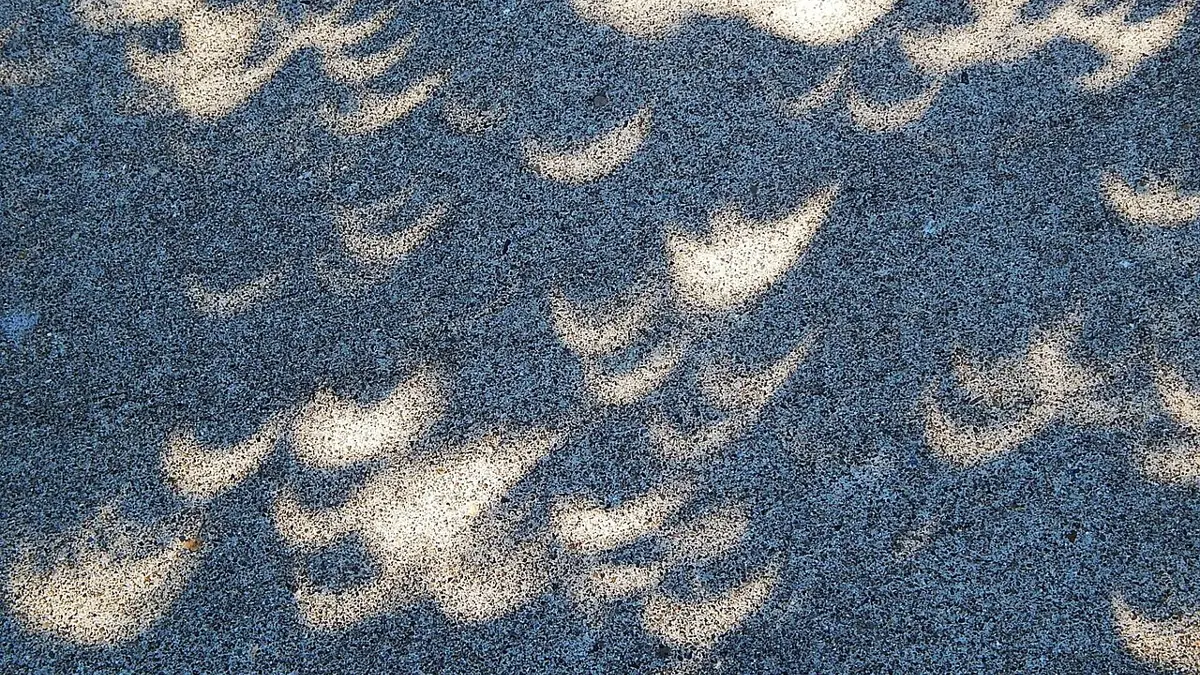
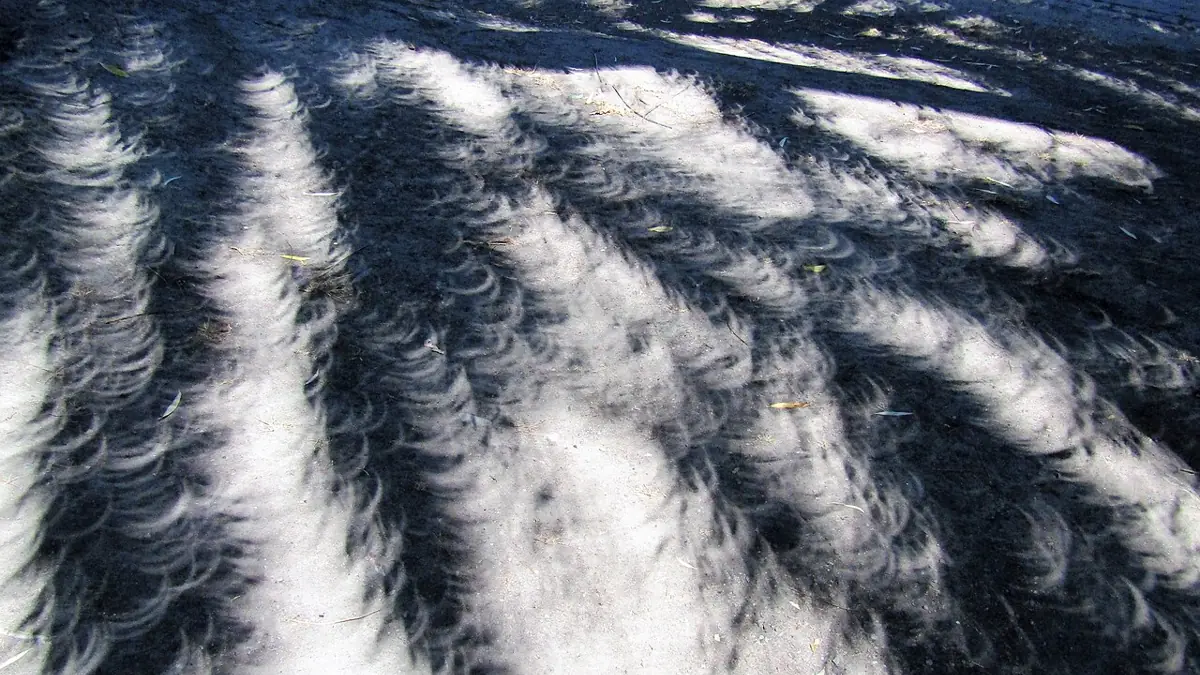
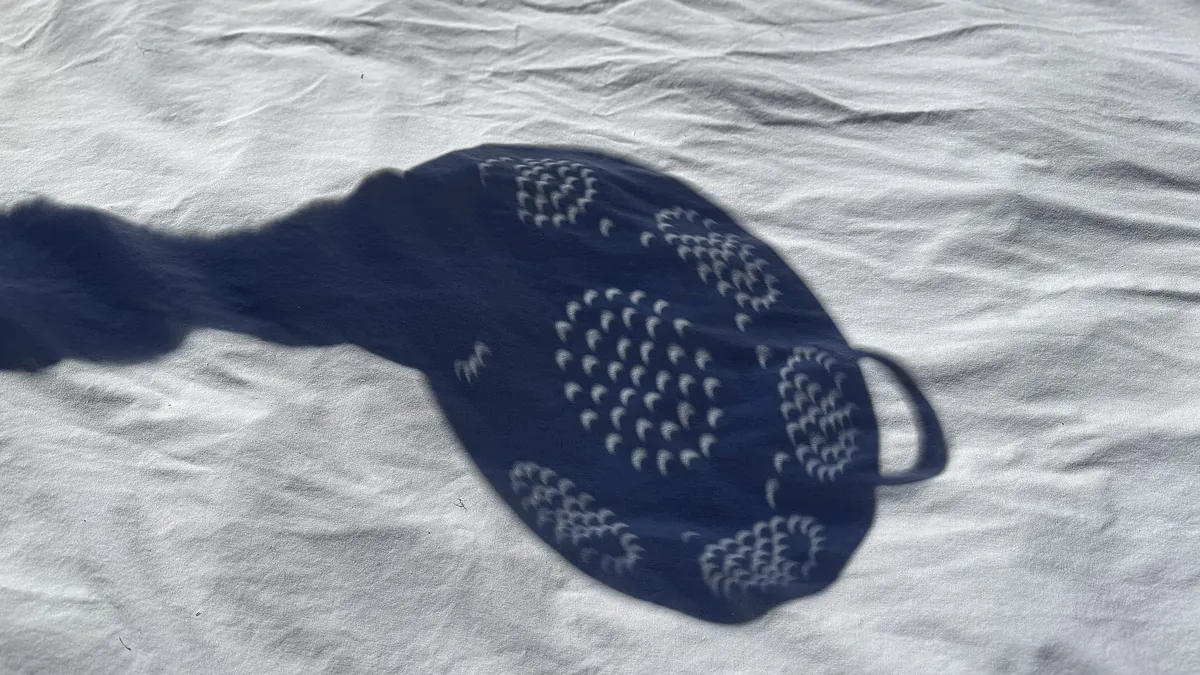
Hold a kitchen colander, a cheese grater or a woven hat above white paper or pale ground. Every hole becomes a tiny pinhole camera, so you get dozens of crescent Suns. Under a leafy tree you'll see the same thing in the dappled shade: one of the loveliest sights of an eclipse.
3. Project with binoculars or a small telescope
Mount binoculars on a tripod (or wedge them steady), cap one side, and point the big end at the Sun without looking through them. Hold a white card 30–50 cm behind the eyepiece, in shade, and focus until the Sun is sharp. Don't leave the binoculars pointed at the Sun for long: the heat can damage them, and never let children use them unsupervised.
View full-size diagram
Scroll sideways to see the whole diagram.
View full-size diagram
Scroll sideways to see the whole diagram.
4. Where to get certified glasses at the last minute
- Local astronomy clubs and observatories often hand out or sell glasses at public eclipse events. Find one near your viewing spot a few days before.
- Science museums, planetariums and libraries on or near the path usually stock them in eclipse week.
- Opticians, camera shops and big supermarkets in eclipse towns tend to sell them, but check for ISO 12312-2 and a reputable maker or its authorised dealer: our eclipse glasses guide shows how.
- Ask around. Eclipse chasers nearly always carry spares and are happy to share a look.
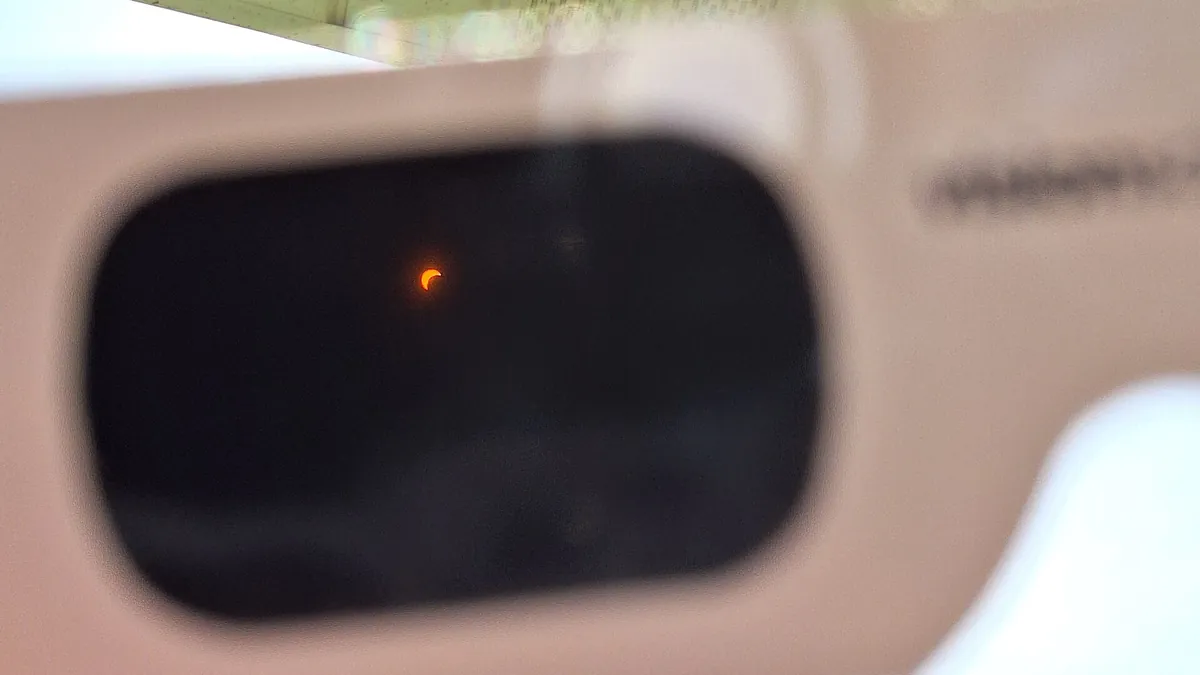
Check any glasses before use: no scratches or holes. Indoors you should see nothing through them except very bright bare bulbs, which look very faint; if you can see ordinary lamps or furniture, they are not dark enough. See our full eclipse glasses guide.
What never to use
- Sunglasses, however dark, and stacked sunglasses.
- Phone screens, tablets or a camera's screen to look at the Sun directly, and never a phone camera pointed at the Sun through binoculars.
- Smoked glass, candle-blackened glass or tinted car glass.
- X-ray film, photo negatives, CDs or DVDs.
- Binoculars, telescopes or cameras without a proper front-mounted solar filter, even with eclipse glasses on.
- Polarising filters, ND camera filters, or anything you are not sure about.
Frequently asked questions
What can I use if I forgot my eclipse glasses?
Project the Sun instead of looking at it: a pinhole in card or foil, a kitchen colander, the gaps between tree leaves, or binoculars projecting onto white card.
Can I use sunglasses to watch an eclipse?
No. Not even several pairs stacked together. They let through thousands of times too much sunlight.
Can I look at the eclipse through my phone camera?
Looking at your phone screen is not harmful in itself, but it tempts you to glance at the real Sun, and the Sun can damage the phone's camera sensor. Use projection instead.
Is it safe to look during totality?
Yes, but only in complete totality inside the path, while the Sun is completely covered. Take your glasses off only when the Sun is completely covered, and put them back on before the first bright sunlight reappears at third contact (C3). Outside the path there is no complete totality, so keep your glasses on, or keep projecting, throughout.
Photo credits
Photos on this page come from Wikimedia Commons and are used under the licence shown. We cropped and resized them to fit; the originals are at each source link.
- Crescent Suns projected through a colander onto a white sheet by Brucewaters, Wikimedia Commons, CC BY 4.0
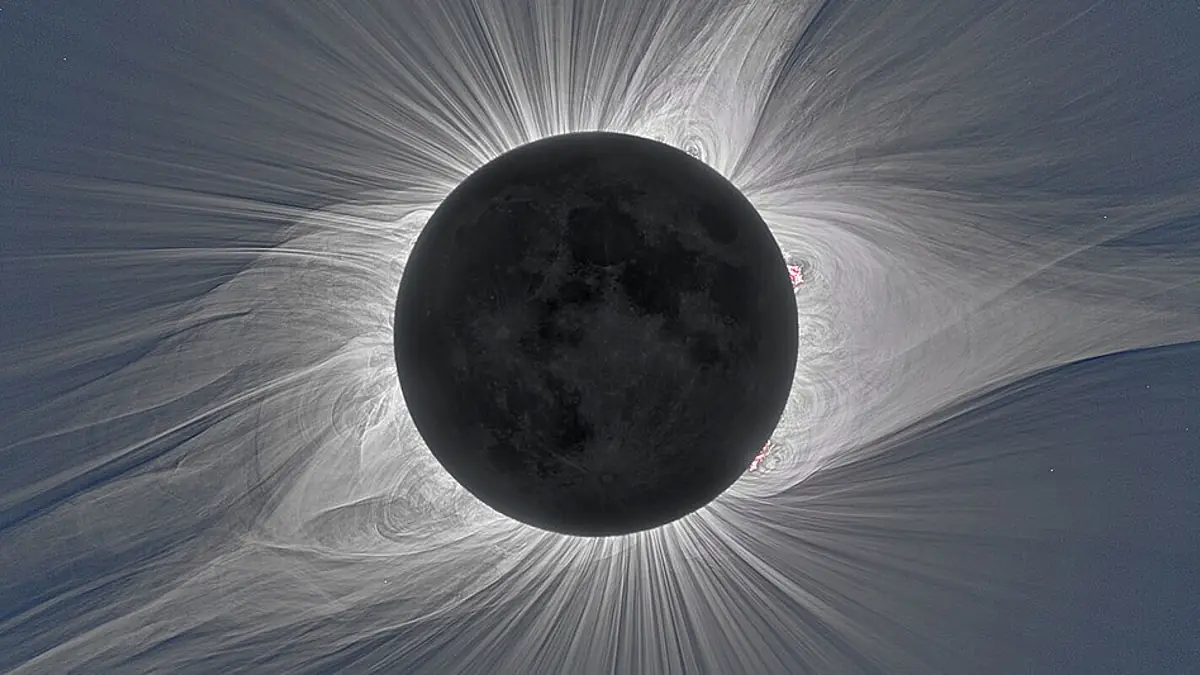
- The Sun's corona during a total solar eclipse by 2009 Miloslav Druckmüller, Peter Aniol, Vojtech Rušin, Ľubomír Klocok, Karel Mar, Wikimedia Commons, CC BY 4.0
- The partially eclipsed Sun seen through paper eclipse glasses by Aaron Lucas, Wikimedia Commons, CC BY-SA 4.0
- Crescent suns cast through leaves during the August 2017 eclipse by Ben P L, Wikimedia Commons, CC BY-SA 2.0
- Crescent suns projected through tree leaves onto a pavement by Ron Clausen, Wikimedia Commons, CC BY-SA 4.0