Photographing a solar eclipse: filters, settings and a shot list
Published · Updated
Two problems glued together: a fierce partial phase that needs a proper solar filter, and, inside the path only, a few minutes of complete totality when the corona is faint and the filter can come off. Plan both, and leave time to watch with your eyes.
Filters first
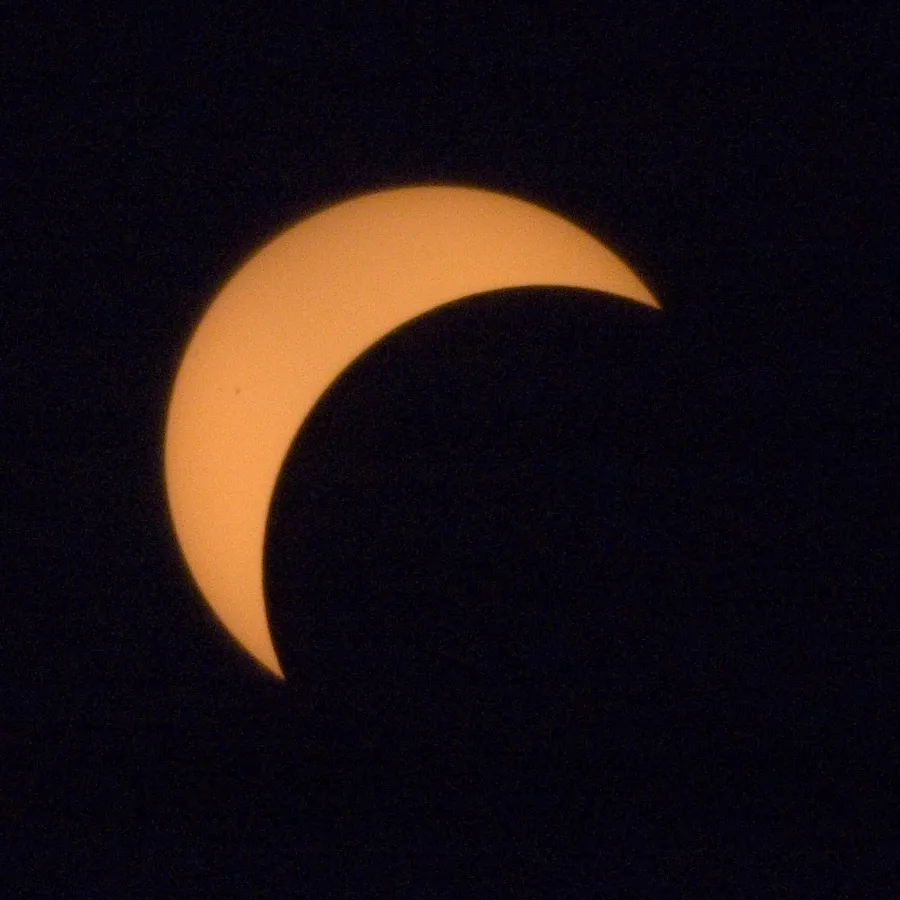
A simple filter turns a blinding Sun into this
A proper solar filter makes the Sun a sharp orange disc you can focus on, zoom into and even catch sunspots on. Without one, you risk your camera, and your eyes.
- 1On the front of the lens, binoculars or telescope. Never just at the eyepiece.
- 2Made for your optics. Camera, binocular and telescope filters are different from eclipse glasses and must suit the specific equipment. ISO 12312-2 applies to direct-view viewers, not camera lens filters.
- 3Off only for totality. Securely back on before the first bright sunlight at third contact (C3).
Camera solar filter
- Purpose-made solar filter, suitable for your lens
- Sized to cover the whole front of the lens
- Reusable for sunspots and future eclipses
Best for: Anyone shooting the partial phases with a zoom lens.
Downside: It has to fit snugly. Check it is secure before every session, and inside the path choose one you can remove and refit quickly.
Binocular and telescope filters
- Fits over the front of each tube
- Sharp, detailed crescent views
- Great for sharing with a group
Best for: A close, steady look at the crescent and sunspots.
Downside: More kit to carry, and it needs a steady mount.
We only recommend purpose-made solar filters from reputable sellers; follow the maker's fitting and safety instructions. Eclipse glasses must never be used to look through unfiltered binoculars, telescopes or camera optics. If you buy through one of our links, we may earn a small commission at no extra cost to you. Affiliate disclosure.
Kit compared
| Kit | Partial phases | Totality | Notes |
|---|---|---|---|
| Phone + mini-tripod | Phone solar filter | Unfiltered, complete totality only | Keepsake; easy to over-shoot |
| DSL R / mirrorless 200–400 mm | Front solar filter | Unfiltered, complete totality only; bracket | Best detail on the disc and corona |
| Wide landscape lens | Solar filter if the Sun is in frame; compose on the screen, never through an optical viewfinder | Unfiltered, complete totality only | Horizon glow, silhouette temples |
| Binoculars | Front filters both sides | Unfiltered glance in complete totality only | Or project onto card for a group |
| Eclipse glasses alone | Eyes only | Off only in complete totality | Not a camera filter |
Partial phases
- Filter on from first contact, and kept on through Baily's beads and the diamond ring at second contact (C2).
- Expose for the bright disc; the sky will look black. Bracket ±1 stop.
- Focus with the filter on, on the uneclipsed Sun, days before if you can.
- C1First contactThe Moon touches the Sun. The partial eclipse begins: glasses on.
- ·Partial phaseOver an hour of a growing bite.
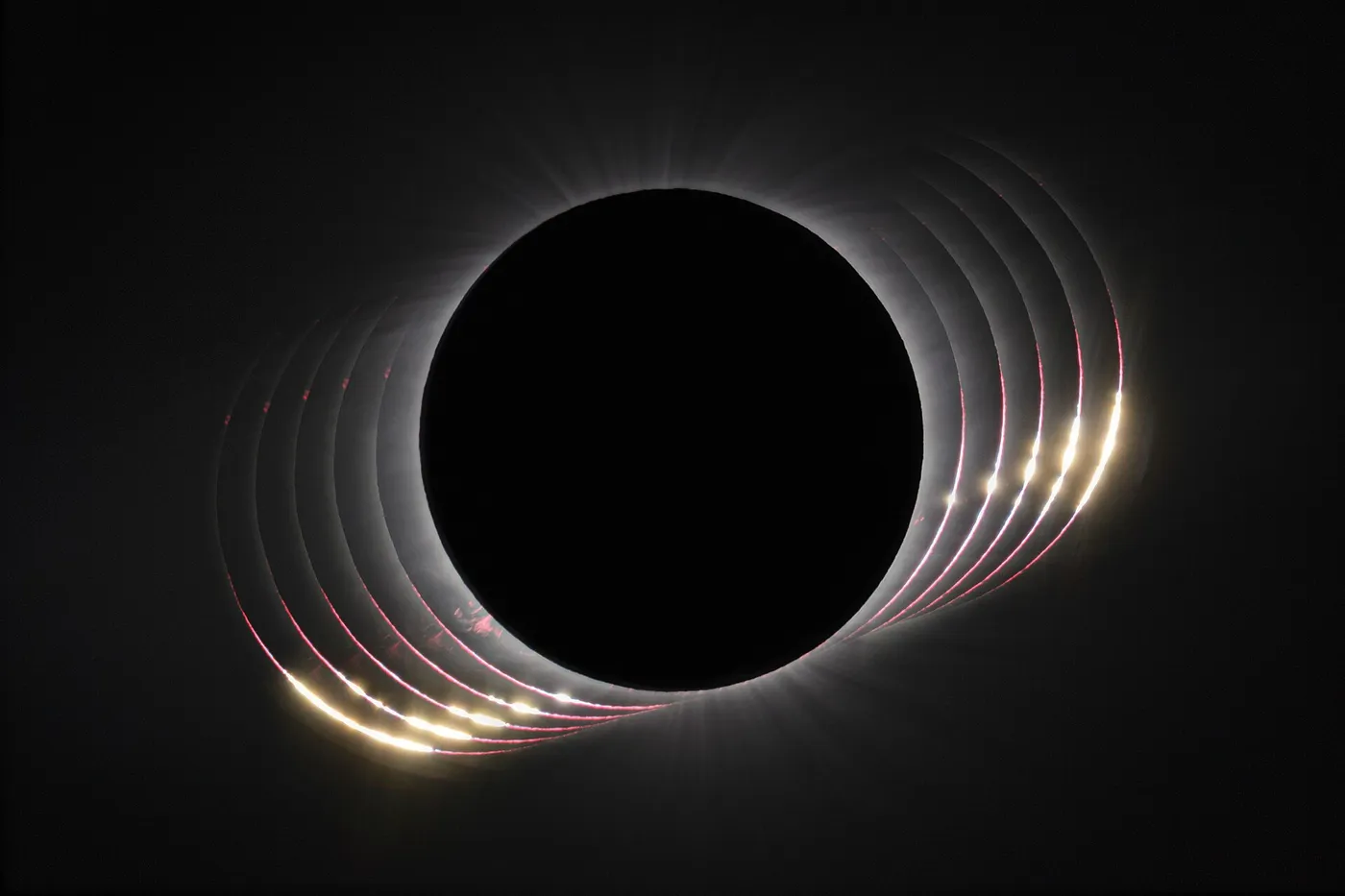
- C2Second contactBaily's beads, then the diamond ring, then totality: glasses stay on until complete totality is confirmed.
- C3Third contactThe diamond ring and Baily's beads again, on the other edge: glasses back on before the first bright sunlight.
- ·Partial phaseThe bite shrinks again.
- C4Fourth contactThe Moon leaves the Sun. The eclipse is over.
Totality
- Keep the camera's solar filter securely fitted whenever any bright part of the Sun is visible. Remove it only during confirmed complete totality, and restore it before direct sunlight reappears.
- The filter stays on through Baily's beads and the diamond ring, and comes off only in full totality inside the path. Refit it before C3, before the diamond ring returns.
- Outside the path there is no complete totality, so the filter stays on throughout.
- Bracket widely: inner corona to outer streamers often span 1/1000 s to a second or more.
- Leave at least a minute with no camera in front of your face.
The diamond ring at the end of totality. The diamond ring contains direct sunlight and occurs at the boundary of complete totality. This guide does not cover photographing it without a solar filter. Keep the lens filter fitted before C2 and restore it securely before C3. Never look directly at the diamond ring without proper eye protection or through an unfiltered optical viewfinder.
Keep the camera's solar filter securely fitted whenever any bright part of the Sun is visible. Remove it only during confirmed complete totality, and restore it before direct sunlight reappears. Take your glasses off only when the Sun is completely covered, and put them back on before the first bright sunlight reappears at third contact (C3).
Complete totality occurs only when the Sun's bright surface is entirely covered by the Moon. If you are uncertain whether totality has begun or is ending, keep your eclipse glasses and camera solar filter on. Use the contact times (C2 and C3) for your exact spot to be ready, then confirm totality by what you see: no part of the bright Sun visible through your eclipse glasses or filter.
Starting exposures (ISO 100, f/8)
Every lens and sky differs, bracket widely. Filter on whenever any bright part of the Sun is visible; off only in complete totality.
| What | When | Filter | Shutter |
|---|---|---|---|
| Partial phases | C1–C2, C3–C4 | Solar filter | 1/250 – 1/2000 s |
| Baily's beads, diamond ring | Around C2 / C3 | Solar filter (stays on) | as partial phases, 1/250 – 1/2000 s |
| Prominences | Complete totality, after C2 and before C3 | Off | 1/500 – 1/2000 s |
| Inner corona | Totality | Off | 1/60 – 1/250 s |
| Outer corona | Totality | Off | 1/4 – 1/15 s |
| Landscape glow | Totality, wide | Off | auto, ISO 400–800 |
What not to do
- Never look through an unfiltered optical finder.
- Do not use ND grads or stacked sunglasses as a solar filter.
- Do not spend all of totality behind the camera.
See also glasses and safety and where to watch 2027.
Frequently asked questions
Do I need a solar filter on my camera?
Yes, whenever any bright part of the Sun is visible. A purpose-made, front-mounted solar filter suitable for your lens is required. Eclipse glasses over the eyepiece are not enough.
When can I remove the camera filter?
Keep the camera's solar filter securely fitted whenever any bright part of the Sun is visible. Remove it only during confirmed complete totality, and restore it before direct sunlight reappears. It stays on through Baily's beads and the diamond ring at both C2 and C3, and comes off only in full totality inside the path. Outside the path there is no complete totality, so the filter stays on throughout.
Can I shoot with a phone?
What focal length works?
A 200–400 mm lens on a full-frame camera records a relatively small solar disc; it does not fill the frame. Longer focal lengths enlarge the disc. Wider lenses capture landscape and horizon glow during totality.
Photo credits
Photos on this page come from Wikimedia Commons and are used under the licence shown. We cropped and resized them to fit; the originals are at each source link.
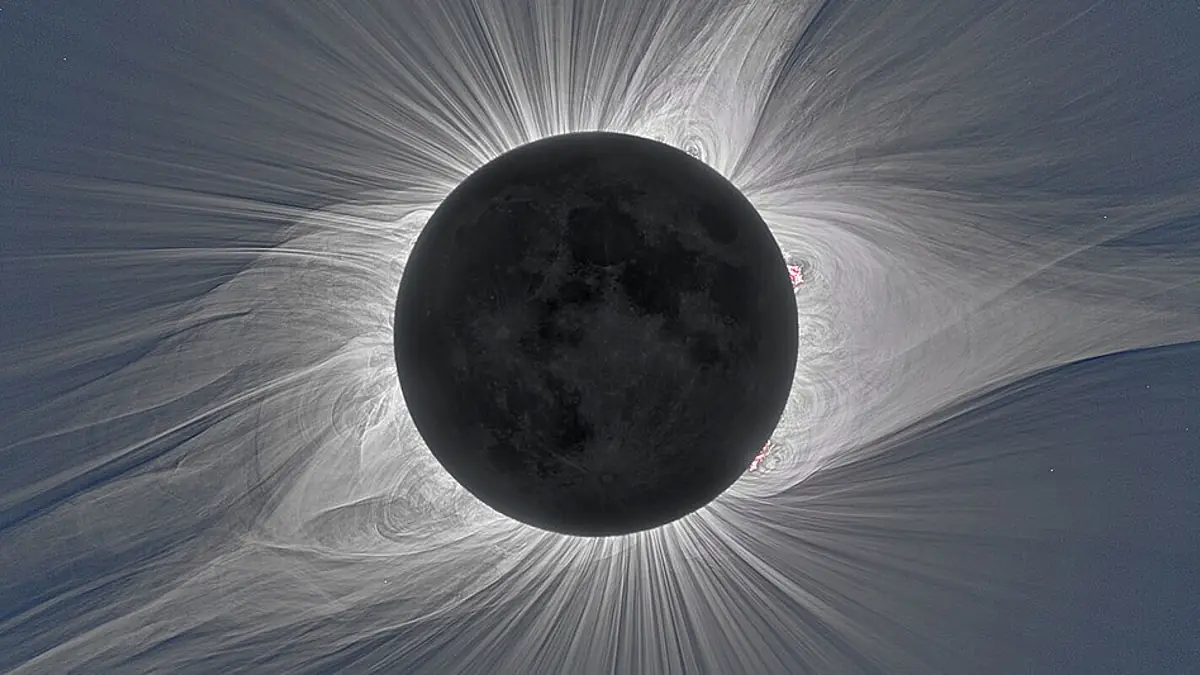
- The Sun's corona during a total solar eclipse by 2009 Miloslav Druckmüller, Peter Aniol, Vojtech Rušin, Ľubomír Klocok, Karel Mar, Wikimedia Commons, CC BY 4.0
- Baily's beads at the edge of the Moon during a total solar eclipse by P. Horálek/ESO, Wikimedia Commons, CC BY 4.0
- A crescent Sun with sunspots during a partial eclipse by Ross Berteig from Monrovia, California, USA, Wikimedia Commons, CC BY 2.0
- A partial eclipse through a solar filter by Matt Hecht, Wikimedia Commons, Public domain